Sleep Apnea Guide

I have sleep apnea and use this blog to provide unbiased info about sleep apnea to create sleep apnea awareness. If you have sleep apnea, it is important to seek treatment.

Showing posts with label CPAP masks. Show all posts

Does your sleep apnea CPAP mask hurt your nose?

A lot of people with sleep apnea do not do their prescribed treatment because they find that the CPAP mask is uncomfortable. Here's a solution that may make treatment easier for some.

A company called SeQual Technologies has joined up with CHI-SAN LLC to make available what looks to be a useful device for those who experience discomfort on the bridge of the nose as a result of the pressure of a CPAP mask.

The Sleep Comfort Care Pad is described as intended for patients with Obstructive Sleep Apnea (OSA) who experience pain and discomfort on or around the bridge of their nose associated with using nasal or full face masks. The pad acts as a cushion between the patient’s face and mask, and is simply placed across the bridge of the nose under the mask.
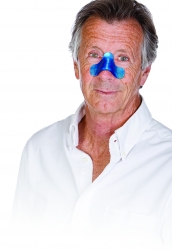
The pad is reusable and can be cleaned with soap and water.

The protective polymer gel pad is composed of USP grade mineral oil, is hypoallergenic, latex and silicone free.


This could prove to be a very useful solution to CPAP mask discomfort.

Traveling with Sleep Apnea Tip #1 - preventing a broken CPAP mask

This tip is for anyone who is using a CPAP machines for sleep apnea treatment. At some point, you will need to travel by airplane with the CPAP machine.

This simple tip will keep you from having a bad travel experience and is based on my own experiences learning the hard way:
  • "When traveling by airplane, pack an extra CPAP mask."
I learned the hard way on a recent trip. I learned that CPAP masks can be too delicate to stand up to the rigors of airplane travel. My CPAP mask broke.

While most CPAP masks are pretty durable, the one point of weakness is at the hinge that connects the upper part of the mask with the lower part of the mask. That's where mine broke.

Luckily for me, part of the hinge remained. I could tape it to keep it in place temporarily.

I thought I had taken every precaution to prevent the CPAP mask from breaking, but I was wrong. I had put the mask at the top of my carry-on backpack but it somehow still broke.

Since a carry-on bag may not have enough room for a back-up mask, put the back-up mask in your check-in luggage. Putting the mask in the middle of clothes in a suitcase gives it protection and is a good place to stash your back-up CPAP mask.

So there you have it, clean out an old mask, stash it in your check-in luggage, and have a great flight.

Bonus Tip: If you don't have an extra CPAP mask because you are new to using a CPAP or you've thrown away old CPAP masks, take extra precautions. Maybe bring some tape or glue in case your mask does break. Superglue may solve some types of mask cracks.

Types of CPAP Masks for Sleep Apnea Treatment

Cuddly Love (Photo by mia3mom)People with sleep apnea should be aware of the treatment options. Did you know there are several types of CPAP masks?

Here's a brief article on the different types of CPAP masks used with CPAP machines for the treatment of obstructive sleep apnea. The article discusses common triangular CPAP masks and the less common oral masks, nasal pillows and hybrid masks.

I've used triangular CPAP masks of both the nose only and nose and mouth variety. The nose mask is the most common type of mask.

I used a nose mask for a few years. It was very easy to wear and get used to. The downside for me, with a high pressure setting on my CPAP, is that the nose mask caused dryness in my nasal passages and required me to either use a humidifier or use saline solution a few times a day.

A second sleep study revealed that the nose mask left me with the problem of breathing through the mouth.

I tried using a chin strap to keep my mouth closed, but that didn't help much, though I only tried one type of strap. There are potentially better chin straps on the market that I have yet to try.

I switched to a nose and mouth full face mask. Full face CPAP masks require more adaption time because the masks must be on tighter to prevent air from escaping from the seams. The first several nights for me were interrupted by the bzzzzz sound of air escaping from the seams. Making the straps tighter then became uncomfortable. Getting to the right balance took time. Oh, the joys of severe sleep apnea!

After the right balance is achieved, the nose/mouth full face mask worked better in my situation. Each situation is different. This article discusses types of CPAP masks and how the masks are used.

View the article here about the different types of CPAP masks.

I've moved. Visit SleepApneaDave.com!!!

Visit my new website about sleep apnea - SleepApneaDave.com for more information about sleep apnea!!!!

About this blog

This website aims to create awareness about Sleep Apnea. I'm not a doctor or an expert on Sleep Apnea. If you have questions, please see your doctor.

Twitter Updates

    follow me on Twitter

    Labels

    Books About Sleep Apnea